
Strengthen Information Systems Audit Skills with CISA Training

A weak information systems audit function rarely fails all at once. It usually shows up in smaller signs first: unclear control ownership, audit findings that repeat year after year, system changes that move faster than assurance work, or risk reports that do not give leadership enough confidence to act.
For organisations that depend on critical systems, that gap matters. Finance platforms, customer records, operational systems, cloud services, identity tools and data stores all carry business risk. Internal audit, IT governance, cybersecurity and compliance teams need the skills to assess those systems clearly and consistently.
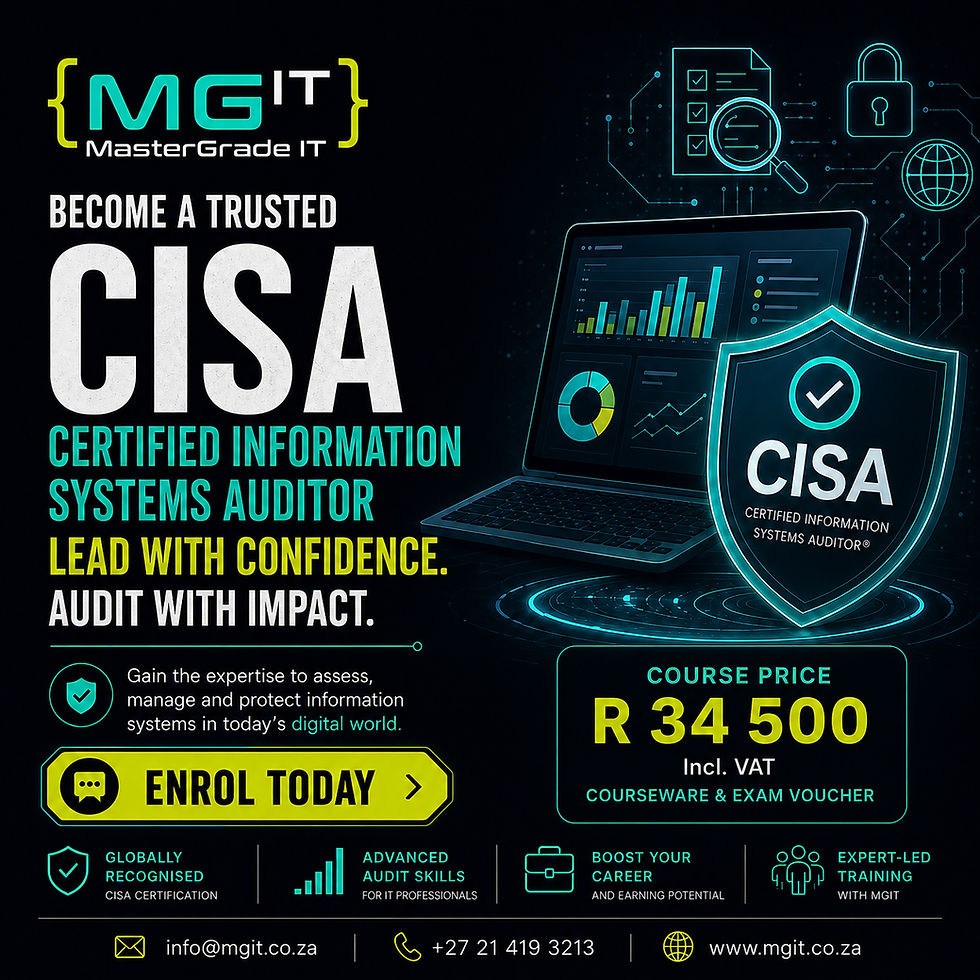
MGIT’s CISA training helps organisations build that capability. The programme equips employees with the knowledge needed to assess, manage and protect information systems, while preparing them for the internationally recognised CISA certification exam.
Why CISA skills matter for modern organisations
Technology risk now sits close to business risk. A failed access control, weak change process or poorly tested recovery plan can affect operations, reporting, privacy and customer trust. Audit teams need to understand both the control environment and the systems that support it.
The Certified Information Systems Auditor credential is widely recognised because it focuses on the link between information systems, governance, controls, risk and assurance. It is not only a technical certification. It also supports the practical judgement needed to review systems in a way that helps leadership make better decisions.
Strong CISA-aligned skills can help an organisation improve:
IT audit quality
Teams can plan, perform and report on audits with clearer scope, stronger evidence and better control testing.
Governance and compliance
Employees can better assess whether IT processes support policy, legal, regulatory and business requirements.
Cybersecurity and risk oversight
Audit and risk teams can evaluate how well security controls protect key information assets.
Internal controls
Teams can test whether controls are designed well and working as expected.
Information systems assurance
Staff can provide more reliable assurance over systems, data and technology processes.
This matters for organisations across South Africa, especially those operating in regulated or risk-sensitive sectors such as financial services, public sector, healthcare, education, telecommunications, retail and professional services.
Who should attend CISA training
MGIT’s programme is ideal for professionals who already work with audits, controls, risk, systems or compliance, as well as employees who are moving into those areas.
The course is suitable for people working in:
Role area | Why CISA training is useful |
IT audit | Builds a structured approach to planning, testing and reporting on information systems audits. |
Governance and compliance | Helps teams assess whether IT controls support organisational and regulatory requirements. |
Cybersecurity and risk | Supports better review of controls that protect systems, data and infrastructure. |
Internal controls | Gives staff a clearer view of how IT controls connect to business processes. |
Information systems assurance | Builds the knowledge needed to provide confidence over system reliability and control performance. |
The course can also support managers responsible for audit teams, risk functions or technology governance. Even when a manager is not performing detailed audit work every day, understanding the CISA domains helps them ask better questions, review findings more effectively and plan staff development with greater focus.
For organisations, the value often goes beyond individual certification. When several employees complete the same training, they start using a shared language for risk, controls and audit evidence. That makes reviews easier to compare and improves the consistency of audit work across teams.

What the training covers
MGIT’s CISA course gives participants practical knowledge across the key CISA domains. These domains reflect the work involved in assessing, managing and protecting information systems throughout their life cycle.
The training supports preparation for the certification exam, but its value is not limited to passing a test. Participants learn concepts they can apply in audit planning, control testing, risk review and reporting.
The information systems auditing process
A good audit starts with a clear objective and a disciplined method. This area covers the audit process, including planning, fieldwork, evidence collection, testing and reporting.
Participants learn how to think about audit risk, scope reviews properly and gather enough evidence to support findings. That helps reduce vague audit conclusions and improves the quality of reports.
For example, when reviewing access to a financial system, an auditor needs more than a user list. They need to understand who approved access, whether roles match job responsibilities, how privileged access is monitored and whether changes are reviewed.
Governance and management of IT
Technology should support the organisation’s goals, not operate as an isolated function. This domain focuses on governance structures, policies, accountability, performance and risk oversight.
For governance and compliance teams, this area helps connect technology controls to broader organisational requirements. It also helps auditors assess whether decision-making, reporting and ownership are clear enough to manage technology risk.
Common review areas may include IT strategy alignment, policy management, risk reporting, third-party oversight and control ownership.
Information systems acquisition, development and implementation
New systems and major changes can introduce risk long before they go live. Poor requirements, weak testing or rushed implementation can create control gaps that remain in place for years.
This domain focuses on how systems are selected, developed, configured, tested and implemented. It is especially useful for audit teams that review projects, system migrations, cloud adoption or major upgrades.
Participants learn how to assess whether controls are built into systems from the start rather than added later as a repair measure.
Information systems operations and business resilience
Once systems are live, organisations need stable operations and the ability to recover when things go wrong. This area covers operational controls, incident handling, service delivery, backup processes and business continuity concepts.
Audit teams can use this knowledge to review whether systems are monitored, changes are managed, incidents are handled properly and recovery plans are tested.
A practical example is a review of backup and restoration. It is not enough to confirm that backups exist. A stronger audit asks whether restorations are tested, whether recovery times meet business needs and whether responsibilities are clear during an outage.
Protection of information assets
Systems hold sensitive and valuable information. This domain focuses on the controls that protect confidentiality, integrity and availability.
Participants build knowledge of access controls, security monitoring, data protection, network security and related risk areas. This supports stronger reviews of how an organisation protects its systems and information assets.
For cybersecurity and risk teams, this domain helps connect security activities to assurance work. It also helps internal audit ask better questions about whether security controls are working as intended.
The organisational benefits of training teams together
Individual certification is valuable, but group training can have a wider effect. When employees from audit, risk, compliance, cybersecurity and internal controls learn together, they build a more consistent view of information systems assurance.
That can improve how teams work across the organisation.
Audit findings become clearer
Weak findings often point to symptoms instead of root causes. CISA-aligned training helps employees assess whether a control is missing, poorly designed, poorly operated or not evidenced.
That distinction matters. A finding about “poor access management” is broad. A stronger finding explains that privileged user access is not reviewed at defined intervals, review evidence is incomplete, and exceptions are not tracked to closure.
Risk conversations improve
Technology risk can be difficult to explain in business terms. Training helps employees connect technical issues to operational, compliance, financial or reputational impact.
That makes risk reports more useful. Leaders can see why an issue matters, what control failed and what needs to change.
Internal audit capability becomes more consistent
Consistency is one of the biggest benefits of structured training. Teams that understand the same audit concepts can plan work more clearly, test controls in a similar way and produce reports that are easier to compare.
This is especially useful for organisations with multiple sites, departments or business units.
Exam preparation supports professional growth
The programme prepares participants for the internationally recognised CISA exam. For employees, this supports career development and professional confidence. For employers, it builds a stronger pool of people who can contribute to governance, risk and assurance work.

What is included in MGIT’s CISA course
MGIT’s CISA course is designed for organisations that want practical staff development and exam preparation in one programme.
The course price is R34 500 incl. VAT.
This includes:
Courseware
Participants receive learning material to support the course and exam preparation.
CISA exam voucher
The exam voucher is included, helping organisations plan certification costs more clearly.
Practical coverage of key domains
The training covers the main areas participants need to understand for information systems audit and assurance work.
Support for corporate bookings
MGIT offers options for group training and employee certification programmes.
For employers, the included exam voucher is especially useful because it keeps training and certification planning connected. Instead of treating exam registration as a separate step, organisations can plan the full development path from course attendance to certification attempt.
How to decide who should be trained first
When planning a group programme, it helps to select participants based on both current responsibilities and future capability needs.
Good candidates often include employees who:
Perform IT audits or support internal audit assignments
Review IT controls, security controls or compliance evidence
Work with governance, risk or internal control frameworks
Support system implementation reviews or post-implementation audits
Need to understand technology risk in more depth
Are preparing for roles in information systems assurance
A mixed group can be valuable. For example, an internal auditor, a cybersecurity analyst and a compliance specialist may each view the same control from a different angle. Training them together can improve collaboration and reduce gaps between teams.
Managers may also include high-potential employees who are not yet in audit roles but regularly work with systems, controls or risk. This can help build a future pipeline of assurance capability.
Getting better value from CISA training
A course has the greatest impact when the organisation treats it as part of a broader capability plan. Before employees attend training, managers can agree on what they expect participants to apply afterwards.
Useful steps include:
Identify priority risk areas
Focus on the systems, processes or control gaps that matter most to the organisation.
Match participants to audit needs
Select employees whose roles connect directly to IT audit, governance, risk, compliance or assurance.
Set expectations for exam preparation
Make time for study and revision after the course. Certification preparation takes commitment.
Apply the learning to current work
Ask participants to review an existing audit plan, control test or risk report using what they learned.
Build a shared control language
Encourage teams to use common terms for control design, operating effectiveness, evidence and risk impact.
This approach turns training into practical improvement. It helps employees use the course content in real reviews, not only in exam preparation.

Build stronger audit and assurance capability with MGIT
Information systems audit capability is no longer a specialist concern hidden inside the IT department. It supports governance, risk management, compliance, cybersecurity and internal control across the organisation.
MGIT’s CISA training programme gives employees the knowledge to assess critical systems with more confidence and prepares them for an internationally recognised certification exam. For organisations investing in internal capability, it is a practical way to strengthen assurance work and improve the quality of technology risk oversight.
For corporate bookings, group training and employee certification programmes, contact MGIT:
Email: info@mgit.co.za
Phone: +27 21 419 3213
Website: www.mgit.co.za
A stronger audit function starts with people who know what to look for, how to test it and how to explain the risk clearly. CISA training gives teams a structured path to build that skill.



Comments